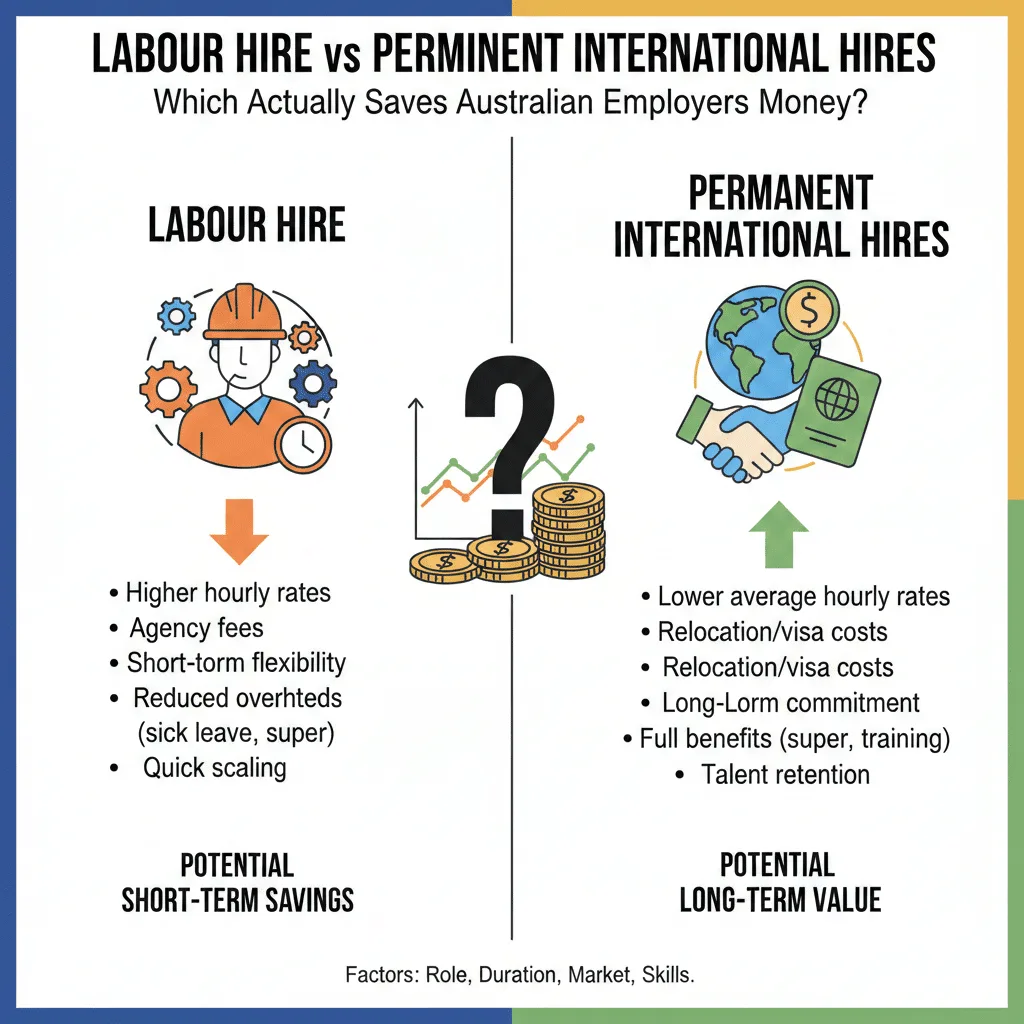
Labour Hire vs Permanent International Hires: Which Actually Saves Australian Employers Money?
For many Australian employers, labour hire has become a default solution — not because it’s ideal, but because it’s available.
When local recruitment pipelines run dry and projects still need to move, labour hire feels like the fastest way to keep operations running. There’s no long-term commitment, minimal paperwork, and someone can be on site quickly.
But speed comes at a cost.
As labour shortages persist into 2025, more employers are stepping back and asking a critical question:
Is labour hire actually saving us money — or quietly costing us far more than we realise?
This article breaks down the real financial, operational, and strategic differences between labour hire and permanent international hires, and why many businesses are shifting away from short-term fixes toward long-term workforce stability.
Why Labour Hire Became the Go-To Option
Labour hire grew in popularity for understandable reasons.
For employers facing:
-
Sudden vacancies
-
Project deadlines
-
Seasonal demand
-
Unpredictable workloads
Labour hire offered:
-
Immediate access to workers
-
Minimal onboarding
-
Flexibility to scale up or down
-
No sponsorship or long-term obligation
In a tight labour market, it often feels like the only viable option.
But what works short-term doesn’t always work long-term.
The Real Cost of Labour Hire (Beyond the Invoice)
At face value, labour hire costs are easy to see — the hourly rate on the invoice.
What’s less visible is what’s built into that rate.
Labour hire hourly rates typically include:
Once all components are factored in, labour hire rates commonly sit significantly higher than the true cost of a permanent employee.
And unlike permanent staff, this premium never disappears.
Productivity: Paid Hours vs Productive Hours
One of the biggest differences between labour hire and permanent employees is productive output.
Labour hire workers often:
-
Rotate between sites
-
Have limited investment in long-term outcomes
-
Require repeated onboarding
-
Operate with lower accountability
Permanent employees, particularly those who relocate internationally, tend to:
-
Invest in learning systems and processes
-
Take ownership of outcomes
-
Improve efficiency over time
-
Integrate into team culture
Over months and years, this productivity gap compounds — but it’s rarely measured.
Retention and Continuity: The Hidden Multiplier
Labour hire models are inherently transactional.
Workers come and go, often with little notice. Knowledge walks out the door. Team cohesion resets repeatedly.
This lack of continuity creates:
In contrast, permanent international hires are typically relocating for stability. They’re not testing the waters — they’re building a life.
Employers consistently report:
-
Higher retention
-
Stronger loyalty
-
Greater long-term ROI
Continuity alone can significantly reduce management overhead.
The Cost Comparison: A Practical Example
Let’s look at a simplified comparison.
Labour Hire Scenario
-
Labour hire rate: ~$86–$91 per hour
-
40 hours per week
-
Weekly cost: ~$3,440–$3,640
Permanent International Hire
Weekly difference:
Savings of approximately $1,100–$1,300 per week
Over a year, that difference becomes substantial.
“But Labour Hire Is Flexible” — At What Cost?
Flexibility is often cited as labour hire’s biggest advantage.
But many employers discover that:
-
“Temporary” labour becomes permanent dependency
-
Flexibility disappears when workers aren’t available
-
Costs remain high regardless of business cycles
True flexibility comes from having reliable capacity, not scrambling for coverage.
Permanent international hires give employers predictability — which is often far more valuable than short-term flexibility.
Onboarding and Ramp-Up Time
A common assumption is that labour hire workers are productive immediately.
In reality:
-
Every new worker needs site induction
-
Safety procedures must be re-explained
-
Systems and standards vary
With labour hire, this happens repeatedly.
With permanent hires:
While international hires require initial onboarding, the long-term payoff is significantly higher.
Safety, Accountability, and Risk
Workplace safety improves with familiarity.
Permanent employees:
-
Understand site-specific risks
-
Build safer work habits over time
-
Are more invested in compliance
Labour hire workers, particularly short-term placements, may:
-
Lack deep familiarity with the site
-
Feel less empowered to speak up
-
Take shortcuts under pressure
From a risk perspective, continuity matters.
The Sponsorship Cost Myth
One of the biggest barriers employers cite when considering international hires is sponsorship cost.
While there is an upfront investment, many employers fail to compare it against:
When viewed over 12–24 months, sponsorship costs are often fully offset — and then surpassed — by savings and productivity gains.
The Payback Period Reality
For many employers, the payback period on an international hire is surprisingly short.
Depending on the role:
-
Payback often occurs within weeks or months
-
After that, the role generates net positive value
-
Savings continue year after year
This is why more businesses are viewing international hiring as a capital investment, not an operational expense.
Culture and Team Impact
Teams thrive on stability.
Permanent hires:
When teams feel supported rather than stretched, performance improves across the board.
When Labour Hire Still Makes Sense
This isn’t to say labour hire has no place.
It can be effective for:
-
Short-term spikes
-
Emergency cover
-
Highly seasonal work
The problem arises when labour hire becomes the default solution for permanent needs.
That’s when costs escalate and problems compound.
Why Employers Are Shifting Their Strategy
Employers who transition away from heavy labour hire reliance often do so after realising:
-
They’re paying a premium for instability
-
They’re managing symptoms, not causes
-
Growth is limited by workforce unpredictability
By investing in permanent international hires, they regain control.
The Strategic Advantage of Permanent International Hiring
Permanent international hiring offers:
-
Cost certainty
-
Workforce stability
-
Higher retention
-
Better long-term ROI
In a tight labour market, this advantage compounds over time.
Final Thoughts
Labour hire can keep the lights on — but it rarely builds the future.
Permanent international hires, when planned properly, offer Australian employers a more sustainable, cost-effective, and stable workforce solution.
The real question isn’t whether labour hire is easy.
It’s whether it’s helping your business move forward — or quietly holding it back.
Check our Process
Socials:
Facebook
LinkedIn