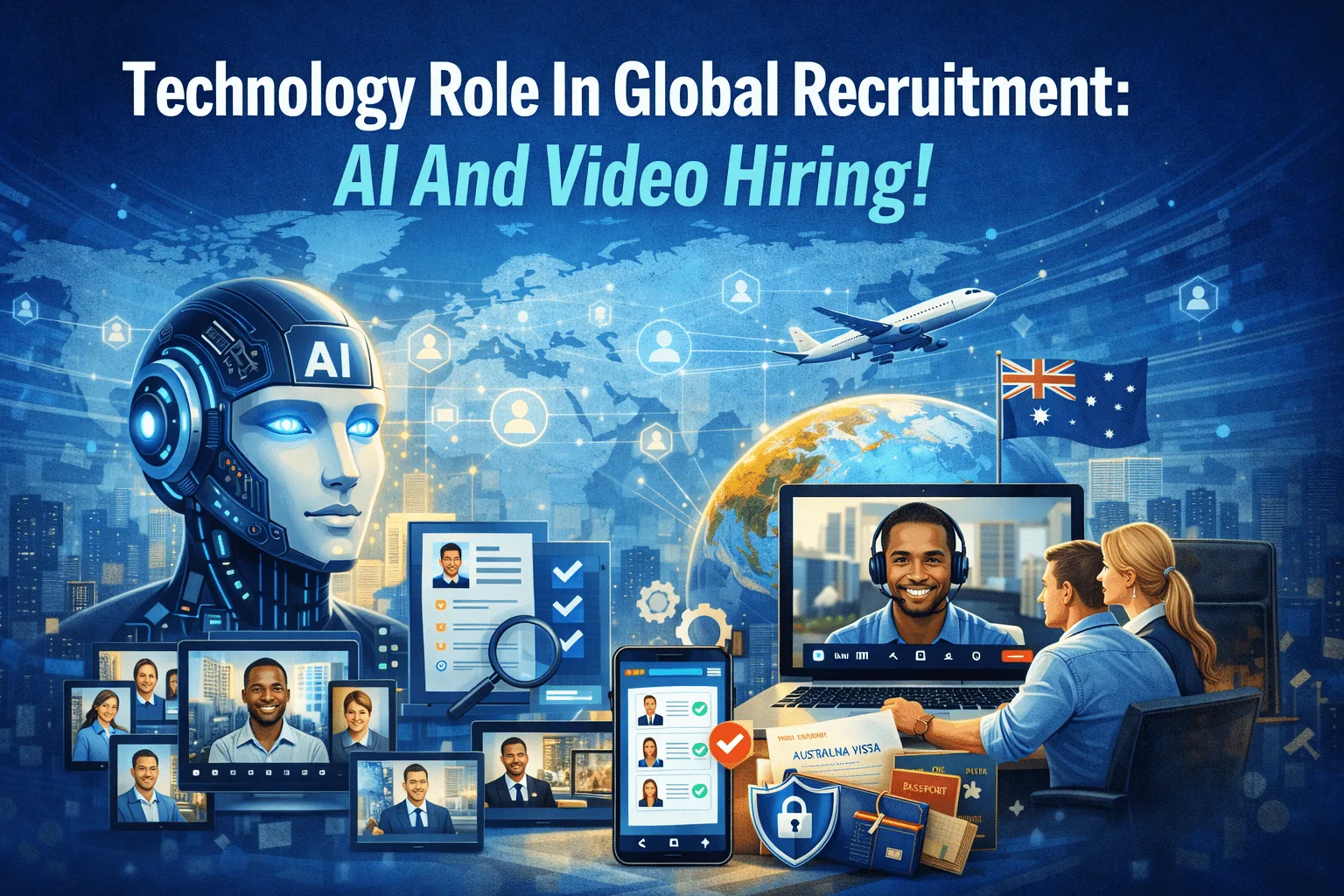
Global recruitment is being reshaped by technology at a pace that would have seemed unrealistic just a few years ago. For Australian employers facing skills shortages, and for South African candidates planning a life-changing relocation, the hiring process must be faster, more transparent, and more reliable than ever. Technology is now the bridge that connects talent to opportunity across borders, while helping reduce risk, improve candidate experience, and support better long-term retention.
Global recruitment in practical terms is being transformed by three tech pillars making the biggest difference today: artificial intelligence (AI), video hiring, and modern talent platforms. When used well, they help hiring managers make stronger decisions, and help candidates feel informed, supported, and prepared for success in Australia.
AI In Recruitment: Faster Shortlists, Better Matching
AI has moved well beyond simple keyword scanning. The best systems now support recruiters by identifying patterns across skills, licences, experience, availability, and even location preferences. In global recruitment, this matters because a “close enough” hire can become costly when relocation, compliance, and onboarding are involved.
AI-enabled tools can:
- Reduce time-to-shortlist by quickly comparing candidates against role requirements, including trade qualifications and role-specific competencies.
- Improve match quality by highlighting adjacent skills, for example a fitter with transferable experience into a similar mechanical role.
- Support consistency by applying the same screening framework across applicants, which helps reduce human error and bias.
That said, AI is only as good as the data and the process behind it. Recruiters still need to validate outcomes, pressure-test recommendations, and ensure that decision-making remains fair. The goal is not to replace human judgement, but to give it better inputs.
A strong approach is to treat AI like a capable assistant: it handles the heavy lifting of sorting and pattern recognition, while recruiters focus on context, motivation, communication style, and cultural fit. In global recruitment, that human layer remains essential, especially when candidates are evaluating a major move for their families.
Video Hiring: Shortening Distance Without Losing Connection
Video interviews have become a standard, but the biggest shift is how organisations use them strategically. In global recruitment, video hiring reduces geographic barriers while preserving the “human feel” that candidates and employers both need.
There are typically three formats, each with a purpose:
- Live video interviews (Zoom or Teams)
Ideal for two-way conversation and assessing communication, professionalism, and rapport.
- Structured video screening
Shorter, consistent interviews that make it easier to compare candidates fairly.
- Recorded video responses
Useful when time zones make scheduling difficult, though it should be used thoughtfully to avoid feeling impersonal.
Video hiring works best when employers create a clear, respectful process. Candidates relocating to Australia often carry understandable anxiety about visa pathways, timelines, and whether a role is truly secure. A well-run video interview builds trust and reduces drop-off.
To lift quality, encourage hiring teams to:
- Share the interview structure and topics in advance
- Include a practical component where relevant (talk-through of tools, projects, safety standards, or work examples)
- Leave time for questions about work conditions, site expectations, and onboarding support
Done properly, video creates momentum and confidence on both sides. That is a major advantage in global recruitment, where speed matters, but reassurance matters just as much.
Talent Platforms: One Source Of Truth For Cross-Border Hiring
Modern talent platforms have transformed how recruitment teams manage candidates, clients, documentation, and timelines. Instead of scattered spreadsheets and email threads, platforms centralise everything.
In global recruitment, platforms are most valuable when they connect the entire journey:
- sourcing and outreach
- screening and assessment results
- interview scheduling
- compliance documentation and progress tracking
- offer management and onboarding steps
For employers, that means clearer visibility into where each candidate sits, and what is required next. For candidates, it means fewer repeated requests for the same information and a more organised experience overall.
Global Recruitment platforms also support collaboration. Recruiters, hiring managers, and migration partners can stay aligned without delays, and every handover is cleaner. That reduces the risk of missed documents, miscommunication, or preventable compliance gaps.
Smarter Assessments: Skills Verification At Scale
In skills-based sectors like trades, manufacturing, and construction, assessment quality can make or break a placement. Technology now supports more reliable verification through:
- online skills testing where appropriate
- structured scorecards for consistent interviewing
- reference checking tools that standardise questions and capture outcomes clearly
- credential tracking for tickets, licences, and certifications
This helps employers move beyond “good on paper” and towards a defensible hiring decision. In global recruitment, it is also a way to protect candidate reputation, because high-quality workers can be clearly differentiated and presented with confidence.
Compliance And Security: Reducing Risk Across Borders
International hiring includes additional obligations around privacy, data security, and documentation. Technology plays a crucial role here, but only when configured correctly.
A good system should provide:
- secure storage and controlled access to sensitive documents
- audit trails that show who changed what and when
- permission levels for internal teams and external partners
- clear data retention policies aligned to regulations
This is particularly important when handling passports, qualifications, and background checks. Global recruitment succeeds when speed does not come at the expense of risk management. Employers want reassurance that the process is compliant and professional, and candidates want confidence that their personal information is handled safely.
Candidate Experience: Technology That Builds Confidence
For relocating candidates, recruitment is not just a transaction. It is a life decision. Technology can either reduce stress or amplify it, depending on how it is used.
The best candidate experience is built on:
- clear timelines and status updates
- easy scheduling across time zones
- prompt communication and feedback
- a central place to upload documents once, not repeatedly
- practical onboarding information that feels tailored to Australia
In global recruitment, even small improvements make a big difference. A simple progress tracker or automated reminder can reduce uncertainty. A video walkthrough of the next steps can increase follow-through. When candidates feel supported, they engage more consistently and arrive better prepared.
Employer Decision-Making: Better Data, Better Outcomes
Technology also helps employers make decisions with fewer surprises after placement. When platforms capture structured data, you can start to answer questions like:
- Which sourcing channels produce the best retention?
- Where do candidates typically drop off in the process?
- How long does each stage take, and what causes delays?
- Which assessment indicators predict performance on site?
Over time, this enables continuous improvement. In global recruitment, that feedback loop is powerful, because it improves both speed and quality without compromising standards.
A Practical Tech Roadmap For Hiring Teams
If you are adopting or upgrading recruitment technology, focus on sequence, not complexity. A sensible roadmap looks like this:
- Start with a platform foundation that centralises candidate data and client workflows.
- Add structured screening and scorecards so every recruiter and hiring manager is aligned.
- Introduce video hiring standards including templates, interview training, and candidate prep.
- Layer AI carefully to support matching and prioritisation, with human oversight.
- Measure and refine using real metrics like time-to-fill, quality-of-hire, and retention indicators.
This approach keeps the process human-led while still delivering the efficiency and clarity technology promises.
What Comes Next: The Future Of International Hiring
The next stage of global recruitment will likely include more predictive analytics, stronger credential verification integrations, and improved candidate communication through mobile-first systems. We will also see more emphasis on responsible AI and transparent processes, particularly as employers focus on fairness and defensibility in hiring decisions.
The winners will be organisations that combine technology with genuine recruitment expertise. Tools create capability, but people create outcomes.
Final Thought
Technology is not just changing how we hire, it is changing what good recruitment looks like. When AI, video hiring, and talent platforms are used thoughtfully, global recruitment becomes faster, clearer, and more candidate-friendly, while giving Australian employers greater certainty and control.
If your business is ready to hire skilled offshore talent with a streamlined, compliant process, RecruitUp Global can help you build a recruitment journey that is efficient, human, and built for long-term success in Australia.